Surveys routinely ask about race and ethnicity, but how we ask these questions matters. The way demographic questions are worded affect who is visible in data, how accurately communities are represented, what insights can be drawn, and the experience a person has as they respond to these questions.
Nearly a decade ago, Best Starts for Kids conducted the first Health Survey to learn more about the health and well-being of children, youth, and families across King County. Over the years, we updated the survey in response to changing needs and community feedback.
Community members told us that we could do a better job reflecting the identities of Indigenous respondents from around the world, not all of whom are well represented by common race and ethnicity options. This feedback speaks to broader issues in data collection and reporting.
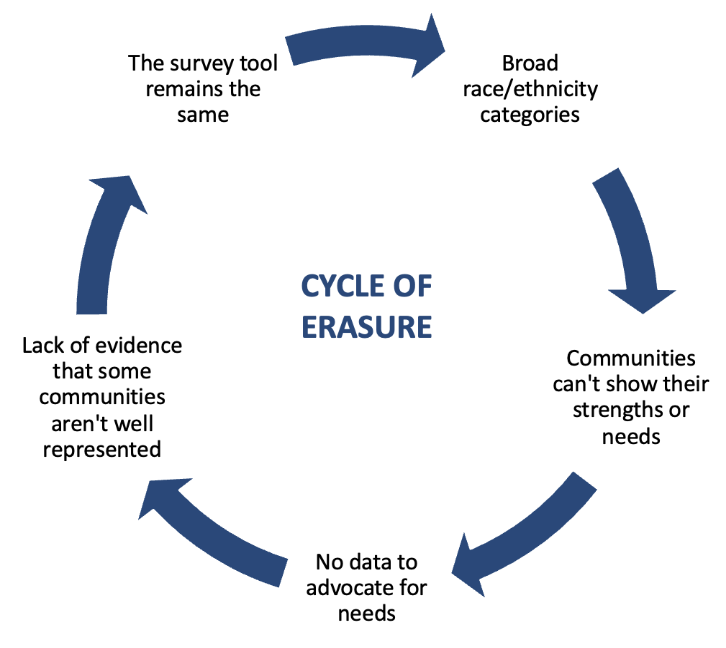
Interrupting the Cycle of Erasure
The exclusion and erasure of Indigenous people in data is rooted in colonial research practices that are deeply embedded in Western systems of data. Indigenous people have always collected, analyzed, and shared data in their own ways that have been ignored and discounted by many “mainstream” data projects. This underscores the need to rethink race and ethnicity measures with Indigenous people, organizations, and Native nations.
Through research and community discussions, we set out to learn how to improve the ways Indigenous identities are measured and reported on in the Best Starts for Kids Health Survey.
Community engagement as part of evaluation practices
We spoke with 15 community members and specialists, who stressed the value of accurate representation in data. Inclusive health data is essential for understanding where communities are located, the size of a population, and the state of community health. For the Best Starts Health Survey, it helps us better understand the experiences and well-being of families with different identities.
One participant described how broad race and ethnicity categories hinder community advocacy and make it difficult to demonstrate the need for more precise data tools.
Participants who identified as Afro-Indigenous, Indigenous to Mexico, or Indigenous to South America said they do not feel represented in common race and ethnicity options, and often select “other”. Many suggested adding more specific Indigenous groups or using parentheses to clarify that American Indian or Alaska Native (AI/AN) is inclusive of these communities. The federal Office of Management and Budget defines AI/AN as people Indigenous to North, Central, and South America, but we heard that many people don’t think of it that way.
When it comes to collecting Tribal affiliation, participants emphasized following the guidance of the Urban Indian Health Institute and respecting Indigenous data sovereignty. Where possible, the Urban Indian Health Institute recommends including a list of all state and federally recognized Tribes with a write-in option for other Tribal affiliations. They suggest defining AI/AN alone or in combination with another race, and releasing data with caution and in collaboration with local Native nations and organizations.
The Report’s Recommendations
We include a variety of recommendations in our report which are intended to be revisited and revised; recommendations should not be static. The following are a few key insights to consider in working toward data equity and justice:
- Pursue genuine collaboration with Indigenous communities to develop and improve data tools (establish a data use agreement, for example)
- Be transparent about why demographic information is being collected and how it will be protected, used, and shared back with communities
- Allow self-identification and multi-selection of race and ethnicity categories
- Collect Tribal affiliation in accordance with the Urban Indian Health Institute’s guidance
- Specify who is included in the AI/AN category or add additional categories to include people Indigenous to Mexico, Central, and South America
- Include specific Pacific Islander groups (at least the largest local populations)
- Disaggregate race and ethnicity data, or in other words, report results for as many groups as possible rather than lumping them together
- Report Indigenous identities alone or in combination with another race
- Recognize local Indigenous languages, original place names, and language revitalization and reclamation efforts
Some of these recommendations affirmed strategies that the Best Starts for Kids Health Survey has always used. For example, we allow respondents to choose multiple races and ethnicities and define AI/AN alone or in combination with other races or ethnicities. Some recommendations led to concrete changes that we incorporated into the current 2026 survey. This includes adding additional race and ethnicity options like “Afro-Indigenous or Black Indigenous”, “CHamoru/Chamorro”, and “Indigenous to Mexico or Latin America”. Other recommendations are connected to our systems work and community outreach in the initiative, like to lift up the experiences and leadership of Indigenous communities in King County.
 Loading…

 Reload document
  Open in new tab
 We want to thank all those who participated in interviews for sharing their time and expertise. This project would not have been possible without the work of Indigenous experts and leaders in decolonizing data and Indigenous data sovereignty.