The School-to-Work strategy connects students with developmental disabilities to employment services while they are still in high school transition programs. At Best Starts we know employment can be an important way for young people to connect and contribute to their community and that it’s essential we invest in supports that reduce barriers and promote success.
We’re excited to release a new report that details the reach of our work throughout King County and identifies opportunities for us to grow this strategy to reach more students and support equity across our community.
Highlights from the report
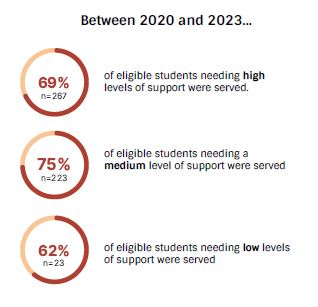
More students who need high levels of supports are enrolling in School-to-Work:
Historically, students who needed high levels of support were less likely to enroll in School-to-Work and overall, less likely to find employment.
Over the last several years the strategy has worked to increase enrollment rates for students who need higher levels of support and make sure that all students who want a job have access to the program. In recent years, students who need high levels of support have enrolled in School-to-Work at higher rates than the average overall: 69 percent of students with higher needs have enrolled in the program compared to 66 percent overall.
Enrollment varies across school districts:
While 66 percent of eligible students are enrolled across King County, the rates of enrollment vary by school district.
We are working with teachers, school districts, and other partners to identify students earlier and to better coordinate services. We are also using the data we are collecting to inform how we can improve enrollment rates across King County while meeting the unique needs of each district and its students.
Share of students enrolled by race or ethnicity
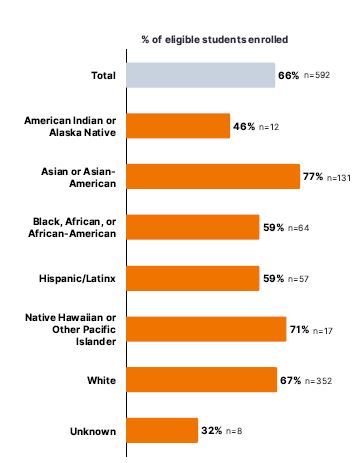
We are looking at how the intersection of a student’s race and disability can make it even more difficult for students and their families to equitably access the supports they need. The data from 2020 to 2023 reflect this, showing that American Indian and Alaska Native, Black, African and African American, and Hispanic/Latinx students are enrolled at lower rates than their peers overall.
We need to build and strengthen lasting and meaningful relationships with BIPOC communities and community leaders to develop outreach plans that address the unique needs of King County’s diverse communities. In addition, we will continue to support employment service providers with training and technical assistance, grow our language access supports, like translation and interpretation, and improve our understanding of the language access needs of students and their families.
Examples of steps we’ve taken to improve language access include:
- Translating outreach documents in 22 languages.
- Offering standing simultaneous interpretation in Spanish, Somali, and Vietnamese for our monthly virtual ourtreach efforts. We also coordinate other languages as requested.
- Partnering with community-based organizations like Washington Multicultural Services Link (WMSLink) to organize S2W orientations for Somali, Tigrinya, Oromo, and Amharic speaking families and students. Through this partnership, families received orientation information in their home language and cultural support from WMSLink staff.
Read the full report:
 Loading…

 Reload document
  Open in new tab